Saturday, September 30, 2006

Your Eschatology Will Shape Your Ecclesiology!

This is Everywhere!

So said David Holden at the Brighton Leaders Conference 2000. I've been thinking a lot about this quote over the past few days. In a sense, the truth of it lingers behind almost everything that the Christian bloggers and authors have been writing or prophesying about!

For example, it lingers behind Mark's meditations on the rightness or wrongness of the mega-church. Why bother trying to build a mega-church if your eschatology is pessimistic (you might call it realistic) and you don't expect much to improve for the Church before Jesus Christ returns again? In fact never mind mega, why bother to build church?

The truth of this quote definately drives the prophecy that I have just transcribed of Terry Virgo's on my "Spirit of God!" website. He brought it at the Brighton Leaders Conference 2003 and it is possibly one of the most Gospel-orientated prophecies I have ever heard. The essence of it is this: "The great work is done! ... Resurrection is established ... A victorious Saviour sends His Spirit among you ... Now I have chosen you. Go and build it! ... Go and proclaim!". Can you sum up the Gospel any better? The finished work of Christ is done! The Spirit has been sent among us! Now go! There is a world to be won!

The truth of this quote is most definately behind the heart of John Piper. In one of his latest books, "What Jesus Demands From the World", Piper wrote; "The universal authority of Jesus issues in a mission that lasts as long as history and extends as far as humanity ... the words, "to the end of the age" show that the mission should last till Jesus comes back. The demand is not given only to the first generation of disciples. The mission lasts as long as the mission-sustaining promise lasts. And that promise is; the all-authoritative Jesus will be with us to the end of the age. As long as there is time and as long as there are nations to reach, Jesus' demand to go and make disciples is valid".

This isn't New!

A mistake that Restorationists such as myself often make is to think that we are the first to hold fast to this positive indeed optimistic eschatology of how things will shape up for the Church. This is a grevious mistake. The first transcript I ever completed was of a Panel Discussion from the Bethlehem Conference for Pastors 1999. The participants were Dr James M Boice, Dr John Piper, C J Mahaney and David Bryant. During the panel discussion the participants were asked to recommend books that particularly had impacted their ministry. I was not alone in finding their commendations note-worthy.

Dr Piper unsurprisingly recommended Jonathan Edwards, Mahaney unsurprisingly recommended books on the Cross, Dr Boice recommended a variety of books ranging from C H Spurgeon to George Whitfield but David Bryant recommended a series of books that I hadn't heard of before. Kenneth Scott Latourette's "A History of Christianity". I took more serious interest in them when I saw them on the library shelves of my pastor Dr Stanley Jebb, but found them to be a little beyond my price range.

I was therefore thrilled today to visit the local S.P.C.K bookshop in Bristol and I found the volumes for £2 each! I duly brought them and am deep into them and finding them just as thrilling as David Bryant promised they would be at the Bethlehem Conference in 1999. Why so? Here are a number of "smooth stones from ancient brooks" from Volume 3 - '3 Centuries of Advance' by Latourette that may sound familiar to our present day situation.

"In the fifteenth century and in the first half of the sixteenth century Christianity faced a major crisis ... The first flush of enthusiasm, characteristic of a new religion was presumably long past. A younger rival, Islam was continuing to supplant it in wide regions and was threatening it's remaining strongholds".

"Much ... was indifferent or even antagonistic to Christianity or sort to control it for it's own purposes. In Western Europe where Christianity had seemed most vigorous, decay had fastened itself on the Church. Ecclesiastical leaders disregarded Christian ethics in their programmes and practices and used their positions to advance their private interests".

"Under these circumstances could Christianity continue to spread? Could it even survive? Had it sufficient vigour to enable it to permeate the new culture of Europe ... to win the nations ... in AD 1500 the outlook was far from promising".

"Yet Christianity not only survived. It also displayed new life. In Western and Northern Europe, it revived, showed more vigour than ever before and made an even deeper impress upon the culture of Europe that it had previously been able to do ... Never had any religion spread so widely. Never had any faith had so great an effect upon so large a proportion of mankind".

"Protestantism was so engrossed in making a place for itself against Roman Catholicism, in working out its own theological positions, in controversies among it's various leaders, and in effecting an organization, that it's members had little leisure for concern for non-Christians outside of Western Europe".

"The ... chief reason why in general Protestants were not active in propogating the faith among non-Christians was that until the seventeenth and eighteenth centuries they had relatively little touch with non-Christian people".

Does the Future Have a Church?

Sounds familiar! It seems to me that many of us are so busy trying to actually believe that the Church can survive against the flood of Islam (not helped by utterances from David Pawson) or survive against the flood of post-modernism or of secularism, that there is little room left for faith that the Gospel is destined for success! Ern Baxter was fond of quoting the verse, "I will build My Church and the Gates of Hell will not prevail against it". He said that verse is often misused by the nervous who huddle together and declare that hell's gates will not prevail. They are safe. Hell's gates can't get at them. But Ern asked since when has anyone been chased by gates jumping off their hinges and running down the road?! That verse meant that Hell's gates cannot prevail in keeping the Church OUT!

Jesus Christ will build His Church to such a degree that the gates of Hell themselves will be battered in from the relentless advance of the Church of Jesus Christ! Rather than taking our theology from the world and the newspapers, we need to reclaim a vision from the Bible itself - our authority - about what it promises for the end-time Church. I am so grateful for these quotes from Greg Haslam (preached at Brighton 2003) that make it clear how powerful such a vision can be.

"People won't even cross the road for a little vision - but they will go to the ends of the earth for a big one".

"Vision is sanctified dreaming".

"Until you find something to die for - you are not really living".

"Visionless people view all change as a threat because they are wedded to the past".

"Visionary people need to seek out other people - preferably with a bigger vision who will fire what they believe".

Let's start believing that He must reign UNTIL He has made all His enemies His footstool! We are in good company - Church history demonstrates that the Church has not only survived before but has flourished before and it will do so again! For as surely as He lives, ALL the earth SHALL be filled with the glory of the Lord!

Saturday, September 23, 2006

Back in Bristol! On the Promises of God.

This post is dedicated to my friend Pete, a faithful servant of God and pastor in London. May the Spirit of God inspire faith, vision and passion in you through these words and remember what you have been anointed to be.

I think the perfect holiday is one in which you can enjoy the rest and relaxation God has granted, yet at it's end you are eager to come back and get back to work. That has been my experience! We landed in Bristol Airport at half past four this morning (*shudder*). It was fine until we got to baggage claim where the handlers were obviously asleep too. But I got back in my car with my friends and turned the engine on and Lou Fellingham burst out singing "Before the Throne of God Above" from the Stoneleigh 1998 album. I have to admit that tears came to my eyes. For two weeks I have missed those touches of live worship that speak of the moving of the Holy Spirit. I can't WAIT to go to church tomorrow!

Life isn't a holiday. Trials will come and did (letters waiting for me on the doorstep). But we have a certain and true foundation. God's promises stand - however we feel and despite how much or little we experience. Bask in this extract from Ern Baxter's book, "The King, the Kingdom and the Holy Spirit" with me for a moment.

"Why do we find it so hard to believe God's promises to us? We have been fed a diet of denigration and humiliation. We've been told that we are nobodies, that we're just a bunch of people waiting to go home to Heaven , that we really have no place down here and that the world belongs to the devil. The world does NOT belong to the devil. "The earth is the Lord's and the fulness therefore, the world and all that dwell therein!" (Psalm 24:1). When Jesus Christ ascended on high and sat down at the right hand of God, God established His kingship forever. He made Him King over the whole earth. Jesus Christ is King of Kings and Lord of Lords and we are His earthly representatives

The Bible says, "The Lord will stretch forth Thy strong scepter from Zion" (Psalm 110:2). Many people wonder, where is Zion? During a visit to Israel several years ago, I stood on the rooftop and asked a learned friend next to me, "Where is Zion?". He pointed in the direction of a knobbly little hill and he said, "That's Zion". I responded, "That's Zion? You mean that's where I've been marching to for 60 years?".

Zion as a piece of real estate is strategically localted. In the days of David it was obviously a strategic military stronghold for the Jebusites. There's no question about that, but it's no Rock of Gibraltar either. It's just a rather ordinary looking little hill, well placed for a certain job. Then I began to think of it from a different perspective. Zion was the place where David put the Ark of the Covenant. There the Holy Ghost began to make Zion the name for the people. Zion stopped being just a mountain and became the people of God. God said in the Psalms, "I have set My King upon Zion, My Holy Mountain" (Psalm 2:6). He was saying, "My people are the place of My Presence. Just as David put the ark on Mount Zion, I have put My Presence in the middle of My people and they are now Zion. They are the people of My Presence and I have set My King on My holy hill of Zion".

Through your praise and worship you make a throne in your midst, and as you continue to praise and worship, you experience the sweeping Presence of the regal Son of God and His angelic escort. He dispenses royal gifts. He comes to remind you that you are the people of His power in this world and that from you will rise a scepter of authority that will prepare the Kingdom to be presented to the Father".

Mark will remember with me a favourite song that we used to sing back in Dunstable.

"Jesus, we enthrone You! We proclaim You our King!
Standing here in the midst of us, we raise You up with our praise!
And as we worship build a throne, and as we worship build a throne!
And as we worship build a throne - come Lord Jesus and take Your place!".

Imagine what a difference it would make if as we all worship tomorrow in our churches spread across the nations, we really began to believe that as we worshipped King Jesus was building His throne among us, and dispensing royal gifts of authority to send us out to present a counter culture to the world! We are the People of God!

Wednesday, September 20, 2006

Together on a Mission 2007!!

Yes still on holiday, but I logged on to check my emails and a few favourite sites and was absolutely thrilled to read that Rob Rufus will be back at the conference next year!! He had an outstanding impact in his ministry and I get a feeling that God isn´t through with us yet! A motivation to keep poised for when bookings open! If anyone isn´t familiar with him, here are the links to my reports from his sessions and exactly what happened when he stood up to speak. Wouldn´t it be amazing if this was the fastest selling out Brighton conference yet? I urge everyone who can - don´t miss this man of God if you can!

Rob´s Training Track Day 1.

Rob Main Session.

Rob´s Training Track Day 2.

Rob´s Training Track Day 3.

Here is the rest of the brief official resume from July´s amazing conference from the site.

Together on a Mission 07 with Mobilise 10 - 13 July 2007

Planning for Together on a Mission 2007 is well underway, come back and visit soon to see who will be joining Terry Virgo & Rob Rufus in Brighton in July 2007. 4,000 delegates attended this year’s Newfrontiers annual leader’s conference, making it the largest to date. This included the highly successive students and twenties stream, known as Mobilise. Over 50 different national groups were represented with some coming from Russia, Zimbabwe, New Zealand, Ghana and Japan.

The week consisted of optional seminars in the morning, followed by times of worship and main meetings which were hosted by Terry Virgo. Some of the morning seminars were themed into training tracks, led by speakers such as Wayne Grudem (USA) and Rob Rufus (Hong Kong). Others were led by such teachers as Greg Haslam (Westminster Chapel) and Philip Greenslade (CWR). Topics included church planting, engaging culture, kingdom mission, signs and wonders, the power of God and the authority of the Bible.

In one of the main sessions, Rob Rufus reminded delegates that there is onward momentum with God when empowered by the Holy Spirit – eloquently summed up using the imagery of an escalator! During a prayer session, Rob picked up the theme from the song This is the year and prophetically stated that a change was coming with the Church set to make a greater impact. This seemed to reflect the title of Terry Virgo’s new book, The Tide is Turning, which was published to coincide with the conference.

In other main sessions Terry Virgo, through the life of Moses, insightfully addressed the life and tensions of a church leader, from both internal and external perspectives.Wayne Grudem unpacked the theme of Jesus being both truly God and completely man, emphatically backing up each point with numerous scriptural references. It was a tour de force by a superb Bible expositor.

Stuart Townend, along with Phatfish and Kate Simmonds, were the main worship leaders. Evan Rogers, from South Africa brought an international flavour when he led worship at the Thursday evening prayer session – a firm favourite with all the delegates.

Thursday, September 14, 2006

Meditations from the Beach!

Having a fantastic time away here. God has been incredibly gracious with the most gorgeous weather and the most amazing sunsets I have ever seen in my life!

I have had plenty of time to transcribe too and am well into the fourth (of 5) message from "The King and His Army" by Dr Ern Baxter. It is such an incredibly important message for our day. I remember when I initially announced that this was the series of messages I was going to transcribe from the Lakes Bible Week 1975, someone rightly asked whether those messages were for "that day" and they are now irrelevant as the Charismatic Movement is not beginning to flourish. Ern Baxter dealt with that issue in depth in the 3rd Message that I have just finished - "A Time of Transition", so I hope that will become clear when I make it available.

I have also had plenty of time to read a lot. I brought a handful of my old Newfrontiers magazines from the past and have been really enjoying revisiting the outstanding material in them. I was struck by this quote by Terry Virgo from the Newfrontiers magazine - August/October 2002. He wrote in his Firstline:

"It has been my longing that the conference (the Brighton Leadership Conference just past) would welcome the Spirit and honour the Word. Why is it that we are so rarely privilidged to experience at the same time the manifestation of the Holy Spirit´s power and true respect for the Word of God? How sad that we so often have to put up with a lack of one or the other. Here was a glorious exception and it gave me appetite to know more! ... I feel like Nehemiah who said, "We are about a great work". He added, "The God of heaven will give us success, therefore we His servants will arise and build!".

I wonder if that lament still holds true today? It is incredible to me that time has flown by so quickly since the Together on a Mission Conference that we have just so enjoyed! The CD - "Praise is Rising!" - is coming out shortly and available here! Don´t miss it! I can´t wait to revisit the powerful times of worship that we enjoyed! But I think I can safely say that I have never seen the Word and Spirit come together so powerfully than at that conference. The outstanding ministry of Rob Rufus - imparting the Holy Spirit to us, combined with careful reverence for the Word of God from men like Terry, Dave Holden, Dave Devenish and of course Wayne Grudem. We are indeed about a great work! Let´s arise and build wherever we are!

Friday, September 08, 2006

Two Weeks Holiday!!

I am HUGELY excited! Tonight myself and a group of friends leave on my first proper holiday for three years (Bible Weeks and conferences don't really count as holidays I think). We are going to a distant island in the Mediterranean so I am feeling slightly like C H Spurgeon escaping to Mentone.

I don't know whether there willl be cyber-cafes or internet access there so no promises as to blogs while I'm away. However if there is I will indeed post as to what God is thrilling me with! I do have a definate plan for not wasting this time as I believe it is a huge gift from God.

1. I am taking about ten books to read that have been staring at me from my library shelves.

2. I hope to finish the "King and His Army" transcripts (Ern Baxter at the Lakes Bible Week 1975) so that I can get back, edit and publish this awesome material and get it out to whoever desires it.

3. I want to have a think about where next to go in my desire to get Ern Baxter's ministry widely available so hopefully will have some definite plans when I return.

4. Above all I want to use this time away from distractions to deepen my relationship with God, hopefully seek for a powerful filling of His Spirit, spend as much time as possible in prayer and fellowship with Him and come back strengthened for the next phase of my life.

So if I can't get to a computer - much love and prayer to all who read this! I trust and hope that you have amazing experiences of God's lavish amazing grace and know a powerful experience of walking with His Spirit. See you when I get back!

xxx

Thursday, September 07, 2006

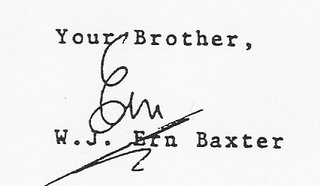
Ern Baxter Signs ...

Wednesday, September 06, 2006

Recommended Bible Study Books by Dr Ern Baxter.

It was an incredibly nice change to receive something exciting in the post today! My great new friend Jonathan Edwards, author of the new blog - "Global Awakenings" - is a fellow fan of Ern Baxter and had a document that I have never seen. It is a list that Ern put together of his recommended books for studying the Bible. It's going to be an amazing resource, but Ern's introductory letter caught my eye and touched on the use of books in a library that I have strongly felt before. This is what he wrote;

"The Great Depression made academic and theological training impossible for me. I partially compensated for this with books. Other sources were subseqently available to me, but I had established a program of personal reading, which I have pursued through the years.

Together with the use of public, institutional and private libraries, I began from my frugal funds to put together the beginnings of a personal library. These were more than books to me; they were the teachings of devout scholars. Since I was deprived access to classrooms and unable to come into direct contact with living teachers, I sought to find out about men whose books were providing information and blessing to me.

It wasn't long until the biographical and autobiographical part of my library began growing. This helped me imagine the presence of the person who wrote the books as my instructor. There are many books on my shelves today that date back to those days, to which I turn, not just in books, but as the writings of men I came to know through their biographies and autobiographies. I sat in their classrooms and in their lectures. I had front pew seats in their churches and I heard their sermons. I sometimes imagined I conversed with them.

I often grieved that I had not been able to pursue advanced formal training. And then I discovered that I was one of a great number of people whose circumstances were similar to mine. Many of their names were well known and their service in the Kingdom of God extensive and influential. Books, I discovered, were also their great instructors and friends. And so, through the years, I have sat at the feet of a great number of fine scholars and devout men of God as they sit on the shelves around me, a great faculty of informing, inspiring instructors.

As I took up pastoral duties, I discovered that there were many young people who for one reason or another were unable to participate in formal theological education. I began offering them such help and instruction as I could give them in classes I convened for that purpose, as well as introducing them to what I felt to be basic books, especially those that had been so helpful to me.

As time went on, I was asked to provide a bibliography of what I considered to be basic books, and this I gladly did. It is certainly not the only bibliography of it's kind, but is designed to help those who want to start to build their own personal library. A number of brothers have contributed to the preparation of the bibliography and the idea of updating it from time to time.

There are many more extensive bibliographies and for the tastes of some, this one may be too elementary. But for those to whom it is useful we are happy to make it available and trust that it will provide you with the kind of informative and inspiring material that will contribute to your desire to more effectively serve God".

I too have enviously looked at men and women who have been able to attend seminaries like Trinity Evangelical Divinity School, Phoenix Seminary or Regent College in Vancouver - although I had the privilidge of spending a month in Vancouver three years ago and was able to photocopy all Ern Baxter's articles that he wrote in New Wine Magazine. Like Ern I would love to sit at the feet of some of my heroes like Gordon Fee, Wayne Grudem or Don Carson but in a very real sense I actually have through their writing! God is so wise in communicating and preserving truth through the written word. There is such immeasurable richness in investing in books that fire ones spirit and passion for God. When I was at university I used to buy any book with a hardback cover - I have now begun to hone my wish list to purely those books that I know will do my spirit good by revealing more of God to me.

Build your libraries!

Tuesday, September 05, 2006

God Wept on September 11th 2001.

I only rarely review books and have never yet reviewed a DVD but I have just finished watching a film that I brought and viewed with great reluctance. "United 93" - the film that covered the fourth plane that was brought down in Shanksville rather than hitting it's target - either the White House or the Capitol.

I guess we all remember where we were on the day that Diana, Princess of Wales died and on September 11th 2001. I had just got into my house from my new job in Birmingham and turned the television when the news broke. I stayed rooted to the television for the rest of the day so it was a day that is rooted in my memory. Furthermore New York has always been a city that for some reason has been very close to my heart, as is the United States of America.


The film is extremely well made and does not seek in the slightest to hype the events of that tragic day. It was made with the agreement of the families of the people who were on board and starts with the passengers (and terrorists) getting ready then arriving at the airport. As the plane leaves Newark, the news begins to break that planes had hit the World Trade Centre in New York. The majority of the film covers the heartbreaking phone conversations between those on the plane and their loved ones. As the film draws to a close it touches on the point that the authorities were tracking the flight and were debating shooting down or crippling the plane if necessary. Finally it covers the outstanding act of bravery as the passengers overcame the terrorists and brought down the plane. The rest as they say is history.

I was amazed at how the pure evil of mankind could be portrayed (the callous desire to slaughter untold numbers of lives) alongside the amazing heroism of mankind (the brave willingness to sacrifice their lives for the sake of saving more). I remember on September 11th 2001, my angry attitude to God was "Why? Why didn't You intervene?". Today my feeling was slightly more in touch, I hope, with the heart of God. I felt His utter sorrow at that day. I do believe He wept as countless thousands of His creation lost their lives and will never again hear His Gospel of grace. Surely John Piper is right when he said; "Sin caused the collapse and sin caused the cross".

Yet the film did more for me than just a general reflection on God's sovereign design on that day. I have heard the prophets in the family of churches I am in speak with increasing regularity of the sure approach of persecution, suffering and martyrdom. John Piper said; "The cross of Christ calls us to suffer and secures our triumph. Suffering is certain. Salvation is sure. And the cross makes all the difference". I have often wondered what I would do if I ever had to face my own death and what factors would cause me to willingly lay down my life. Love? I have very close friends who I do love, and a family and a church. But love was present on United 93 - that was so evident. I hope and pray that I will increasingly gain a vision of God and His Kingdom that is worth laying ones life down for! What is that vision? The Gospel spreading across the world and the witness of that.

"When he opened the fifth seal, I saw under the altar the souls of those who had been slain for the Word of God and for the witness they had bourne. They cried out with a loud voice, "O Sovereign Lord, holy and true, how long before you will judge and avenge our blood on those who dwell on the earth?". Then they were each given a white robe and told to rest a little longer until the number of their fellow servants and their brothers should be complete, who were to be killed as they themselves had been" - (Revelation 6:9-11 ESV).

It seems to me that there is incredible eternal recognition for martyrs. There is rest. But it also seems that there is a set number of martyrs and when that number is complete then God will act and move to avenge their deaths. So rather than martyrdom being something to dread, fear and avoid - rather it is something to look for, long for. Can there be any greater honour than to die for the Gospel and in witness of it? I always longed to be married but I am beginning to believe that there could be some purpose in my living a single, celibate life. Paul wrote; "To the unmarried ... I say that it is good for them to remain single as I am" - (1 Corinthians 7:8 ESV).

I am so grateful for this marvellous documentary of the bravery of human beings. Unlike many films and the dreadful thing that is TV, it is actually made me think and consider what really matters in life - above all preparing for the life that is to come. My prayers have gone out to the families of those who were bereaved on that day - that the God of mercy would comfort them and indeed bring them to see the Gospel for what it truly is. Oh that there could be some eternal good come out from that awful day! Or as John Piper put it: "Oh, that every American would say, "Far be it from me to boast except in the cross of our Lord Jesus Christ" (Galatians 6:14)". And I would add "human being".

Sunday, September 03, 2006

"Life on Wings" - by Dr Ern Baxter - Part 2.

Part 2 of this classic sermon.

Mounting Up on Wings: The writer of Proverbs said that among those mysteries of the universe were too hard to understand, one was the "mystery of an eagle in the air". The symbolism of this passage is the Christian's inexplicable potential which is like the eagle's, which can fly higher than any other bird and never wiggle a wing. What do I mean by "wiggle a wing?". Did you notice that the psalmist said that eagles "mount up" and not "flap up"? Eagles were not made to go flapping about. They were created to soar high and free. Eagles learn to fly without struggling becasue they understand the air currents. An eagle will perch on a rock and wait, testing the winds. When the right wind is blowing, he lifts into the air with a royal scream. Herein is one of the eagles secrets in being able to mount up - waiting. Those who wait, says the scripture, will be the ones to mount up. "They that wait upon the Lord shall renew their strength".

High Flying: Something in an eagle demands that he fly higher than all the other birds. He often flies well beyond the view of the naked eye. He rises past the telephone wires, where the crows screech, "Caww, caww, stop and we'll give you the latest on the Sunday school superindendent, Caww, caww". But the eagle calls back, "I'm not interested! I'm going up beyond the clouds where I can look full into the face of the sun". Even though an eagle flies high into the blinding sun, he is equally adapted to dark mountain valleys. He has two sets of eyelids. With his earthly eyelids he can see perfectly well down at ground level, or he can roll down his heavenly ones and play in the glaring glory of the sun.

Christians must know how to walk on the earth as well as fly in the glory. It is possible to become so spiritual that we cannot see reality in our daily lives. As the eagle mount high above the clouds, he sails those great air currents into the very Presence of God. You and I are not fashioned for the dirt and pollution. We were not born to be dirty crows on a telephone line. We are appointed to the pure worship of God, to climb into the rare atmosphere of the holy of holies.

How High Can We Go?: Some ask, "How far can I go Baxter?". "Enoch walked with God and he was not: for God took him" (Genesis 5:24). That eagle flew high! One day he flew so high that God said, "Enoch, it is closer for you to come up than to go back". How high? George Mueller was once told by a captain of a ship on which he was a passenger that the ship could not make New York on schedule because of dense fog that had set in, "We'll see about that" said Mueller. As Mueller prayed, the fog lifted and the boat hastened in towards his waiting appointment in New York. People can say, "I don't believe that God lifts fog!". They will stay in a fog but God lifts fogs for people who have the faith to have fogs lifted.

God has made us eagles like Himself and He wants us to fly! All the experiences that we become so excited about - our conversion, our baptism in the Holy Spirit, the spiritual gifts - are but a part of the introduction to the supernatural life that demands us to become God-like, because we are partakers of the divine nature.

When Eagles Die: Every eagle will have his downtime. He may be sick or molting but he never panics. He finds a rock and sits there letting the healing power of the sun do it's work. If you find a low place in your life, do not start running around trying to find God - for the people will say to you, "Here is Christ, there is Christ" and it will bring you frustration. David said, "I waited patiently for the Lord" (Psalm 40:1). God often has a work to do and all we are asked to do is to wait. There will come again a time of mounting up on wings, but the waiting must come first. Every eagle knows when his time for death has come. He finds a high rock where he can watch the setting sun and settles down to wait and then dies watching the sun.

There is only one picture on my study wall and it is that of my saintly maternal grandmother. When I was a very young child, Grandma took over much of my rearing. My earliest memories are that of toddling up to the picturesque little picket fence in front of her home on a Saturday morning, looking forward to all the delicious smelling goodies that she took from the cavernous depths of her vast old-fashioned oven. How I loved her. Because of the religious confusion that was in our home, I walked in rebellion as a teenager, but Grandma never let go of me. She was living in our home by that time and I can remember well stumbling into the house at three or four o'clock in the morning and seeing her light shining under the door. I could hear her sobbing, "Oh God, oh God!". Even though I usually felt like kicking the door down I knew that it meant something.

Grandma's Answer: The time came when God got me. I had dissipated my life until I was a moral, physical and spiritual wreck before He found me. Using what musical talent I had, I set out in the Lord's work and soon found myself in the ministry. Grandma ended up moving with us to Vancouver, BC where I found had my first important charge. She came to every service and sat in the front row and just smiled at me. (I don't think she heard a word I said). She was saying, "You answered Lord, You answered". She was nearly eighty and had the most beautiful white hair that you ever saw. Every day for four hours Grandma would sit out in her old rocker and rock out an anthem of praise and supplication to God for me. Her prayers sustained me in a way that I was to realize only after she was gone. One day when I was with her she suddenly said, "I'm going home". "Home?" I asked, "Home where?". "I'm going home to be with the Lord" she replied as if it were something quite ordinary.

"Oh Grandma" I objected, "don't do that!". "Yes" she insisted, as though she and the Lord had talked it over and it was setlled. A little unsure of what to make of it, I asked, "What are you going to do?". Quite positively she answered, "I am giving notice on my room. I will go back to the prairies to spend Christmas with the children and then I am going home".

Looking Into the Sun: That is exactly what she did. With Christmas only three months away, she went back to the prairies for the holidays, wrote her Christmas cards and put everything in order. When she was ready, she called all the children together and did all the decent things that one does when one dies. She called for the pastor and had him read her favouite Psalm (she was two verses ahead of him by memory) and told everyone goodbye. When she had attented to everything she turned her face toward the sun and slipped into the Presence of God. Grandma was an eagle. She died as eagles die, looking into the sun. Somehow I think this is how saints were meant to step into eternity.

There is great reward in God for those who will dare to be eagles and learn to soar into what God had purposed us to be. God is calling us to press into Him and rise higher in Him. He is calling us to new heights of divine awareness, new decisions and a new set of priorities. He is calling us to be eagles.

Saturday, September 02, 2006

"Life on Wings"- by Dr Ern Baxter - Part 1.

Finally - the sermon that inspired the name of this website! I have had an increasing number of people request this classic sermon. Most notably a new friend that I am thrilled to meet - Jonathan Edwards, who has just started up a new blog "Global Awakenings". I think that we have much in common. He dedicates his blog to: "all who passionately long and live for spiritual awakening in our world today". Amen to that! So Jonathan, this transcript is dedicated to you.

"Since the beginning of man's record of himself, the challenge of flight has captured his imagination. The conquering of the air in our own generation has produced a wave of awe and romance unequaled in the annuals of man's existance. Somehow the ability to fly has epitomize the longing of man to rise above the natural limitations of earth-bound mortals and soar into the realm of the supernatural.

God has made provision in His Kingdom for man to have this spiritual need met, and yet few believers ever find the satisfaction of knowing fully what God has allotted to them. How can a man break into the realm of the supernatural in his walk with God? In one form or another this question seems to be one of the pressing concerns whereever I travel. Rather than embarking on a heavy dissertation, I want to look at a beautiful illustration used by the prophet Isaiah;

"But they that wait upon the Lord shall renew their strength; they shall mount up with wings as eagles; they shall run, and not be weary; and they shall walk and not faint" (Isaiah 40:31).

King of the Birds: This passage speaks of the eagle. As the lion is the king of the beasts, so the eagle is the king of the birds. The Holy Spirit has likened us and our Godward aspirations to the aspiration of being like the eagle. As I watched the eagles in the Columbia Basin near Portland, Oregan, I began to understand why they have represented throughout time the Godward thrust of man; power, freedom, beauty, the lord of their environment through their ability to master the air. They move in regal splendour for they are born as kings. As the eagle is born with the divine right of kingship, so we come from the new birth with the inherent potential of soaring into the Presence of God Himself. The fact, however, that eagles are so equipped does not necessarily mean that they will never get off the ground.

Deuteronomy 32:11 has some interesting information about the eagles. "As an eagle stirreth up her nest, fluttering over her young, spreading abroad her wings, taketh them, bearth them on her wings". All eagles begin as eaglets and before these unseemly, squalling fledgings take their place with royalty, they must be trained in the ways of the king of birds. This little verse is the Flight Training Manual of student eagles and earthbound Christians.

The Eaglet's Lesson: Picture with me two little eaglets snuggled cosily in a down-filled nest, high on an eerie ledge on some remote mountainside. (Christians often find themselves born into equally precarious circumstances). Everything is just wonderful. Mother Eagle sallies forth daily and brings back choice titbits for those ravenous appetites. During the cold mountain nights, she snuggles over the nest and the eaglets snuggle securely under those warm, soft wings and look out at the stars not very far away. They are newly born and baptized in the Holy Spirit. Hallelujah! Life is wonderful and being a Christian sure makes life easy - no more problems! God knew what He was doing when He thought up this arrangement!

One day Mom begins to act very strangely. Rather than landing on the nest she hovers momentarily beating the air with those great wings. As Junior watches her, he thinks, 'Mom sure has powerful wings!'. That is exactly what Mrs Eagle wants Junior to know. Then she does something downright crazy. She graps a piece of the nest and drops it over the side of the cliff. Then she returns for another chunk and another and another. The eaglets are starting to think that Mom has lost her marbles! By now the framework of the nest is pretty shaky and that nice soft down that made Junior feel so secure is at the bottom of the canyon. Nest life is becoming a standing room only situation on what is left of their home.

Can you see what the mother eagle is doing? She is preparing her young for the first stage in the eagle training. After our Lord received the Holy Spirit and the declaration of His holy Sonship, the Scripture says that He was led of the Spirit into the wilderness to be tempted of the devil. I have written in the margin of my Bible at this point, "Is this standard operating procedure?". I believe that God's modus operandi is to begin to confront us as soon as possible with the necessity of maturing into something other than nestbound believers.

Growing Up: Paul told the Corinthians that he could not talk to them as mature men because they were as babes (see 1 Corinthians 3:1). He did not say they were babies. But that they were like babies. When a baby slobbers its pabulum down its little chin and milk runs into its little ears, we all laugh and think it is cute. But when a twenty-one year old man slobbers his food down his chin, then he is like a baby and this is sickening. God does not mind a Christian going through the pabulum stage; it is a part of growing up. But it is tragic in God's eyes when we never grow out of infancy.

Interestingly enough the discomfort of our bewildered eaglets has been deliberately caused by the one who loves them most. How often when we have a streak of trouble, do we cry out, "The Devil is attacking me?!". Are you positive it is the Devil? Maybe it is the One who loves you the most who is stirring up your nest. Like many believers, the little eagles conclude that standing on the windy ledge is at least tolerable and they can make the most of it. But dear old Mom has more in her mind than just a nest stirring. She catches one of the little fellows in her powerful beatk and nudges him toward the edge of the ledge. The poor little guy wonders what is happening now. His little heart is beating faster and faster and as he is pushed closer to the edge he thinks, 'No it can't be! Mother wouldn't do this to me!'. But she does.

Out of the Nest: With one final push he starts to plummet to the bottom of the canyon - he is sure this is the end. Then out of nowhere there is a swosh of Mom's mighty wings and Junior is heading back for the safety of the ledge on her powerful back, quite relieved. The first time God kicks us out of the nest and catches us before we hit bottom, we gasp, "Oh thank heavens! I was sure God had let me down that time". Back on the ledge our would-be king is just getting over being dizzy when Mom starts pushing again. "Not again" he moans as he starts his second tumble. "What if Mom doesn't make it this time?". But she does. Several trips later Junior begins to get the feeling that Mom is trying to get a point across. Between rides he suddenly remembers Mom's huge wings hovering over the nest and thinks, "I wonder if ... If she does that again, I'm going to give mine a try!". Rest assured he gets another chance. Mom will not stop until Junior finds the gumption to try his own wings.

Little eagles are gangly creatures, wobbling shakily on untested wings. But each desperate plunge brings a little more mastery of his wings. One day he spreads those wings and rather than falling, he finds himself rising up and up, riding the mighty air currents far above his ledge home and the nest that confined him. No longer a fledgling begging for tid-bits, he is learning to become one of the eagles - he will be a king. Ministers and evangelists often make becoming a Christian as being born on a satin pillow with a cordon of angels wafting us through life and depositing us at the foot of the celestial throne. Only are we are well settled in our nest, do we learn that God is more intent on the production of character than the provision of our comfort.

Living as a King: The Bible land knew two types of eagles; the golden eagle and the imperial eagle. The golden eagle speaks of us as partakers of the divine nature and the imperial eagle speaks of us as kings. In the Scripture, the two go hand in hand. Our divine right to reign as monarchs in our own lives! The circumstances that confound and befuddle the world become launching pads to new heights in God. Satan and his henchmen become the snakes, which an eagle bisects with a slash of his mighty talons or drops from a dizzy height to be crushed on the rocks below. This is our inheritance.

Some years ago I was managing a campaign in Cleveland. Upon departing the city for a few days, I told one of the committees, "Get a plot of ground where we can pitch a tent for about three thousand people and we will take care of the expenses later". When I got off the plane upon my return, the chairman met me and said, "We have a wonderful place for the tent". "Wonderful" I said, "How much did you have to pay for the land?". "Fifteen hundred dollars a day". "What?!" I gasped. (Back in those days fifteen hundred dollars was like fifteen thousand today). We had decided not to make a big thing of money so there was little we could do but trust God. After the first day and a half, we were five thousand dollars down - a rather awkward place to be.

That afternoon I preached on Romans 5:17 which says we reign in life by Christ. As I finished, I said, "Now as you meet one another for the next few days, address each other as 'King So-and-so'. You may address me as King Baxter". That night I was handed an envelope addressed to 'King Baxter'. I opened it and read a delightful note. "Dear King Baxter, my wife and I have a feeling that our fellow king has a need. Our of our royal treasury we wish you to accept the enclose cheque for five thousand dollars". I may not always have it, but there is money in the royal family tree.

Next: How to Mount Up, Flying High and How High Can We Go?

Thursday, August 31, 2006

"Taking Your Mantle and Running With It"

Learning the Lessons from "The Shepherding Movement" by S David Moore.

While this is partly a book review, it may turn out to be somewhat of a more extended reflection on the vitality of recognising leadership. "The Shepherding Movement" by S David Moore is an excellent book that will appeal on many fronts.

It is a scholarly work (the author is a Professor in California), it is a sympathetic work (the author used to be personally involved in the Shepherding Movement), it is a systematic work (the author has taken great pains to ensure historical fact and the bibliography is 20 pages long!) and it is a significant work (the author was granted interviews with Charles Simpson, Bob Mumford and many of the key players in the Shepherding Movement).

I have now read it a number of times and read it firstly for a learning experience, secondly to absorb Ern Baxter's contribution to the Shepherding Movement but thirdly to learn the lessons from history and see where these outstanding men fell short, and by learning we can go further. Regular readers of this website may be forgiven sometimes for thinking that I see Ern Baxter is almost infallible! On many fronts, I have argued that Ern Baxter was incredibly prophetic for his time and his teaching has gone beyond our experience today as charismatics. Yet there are areas where we can benefit from his foundational work and yet go further in our vision of the Kingdom of God. He would expect nothing less.

A. An Outline of the Book.

The author takes a largely chronological format beginning with some time in the foreward to establish his credentials. Why is the book important? "The story of the Shepherding movement provides the contemporary church ... with a highly relevant chronicle of the challenges and problems that involve the renewal and revitalization of church structures" (p4). There should be personal benefits too to reading this book; "Studying the Shepherding movement's successes and problems in its attempts to provide an environment for practical discipleship and spiritual formation may help today's church do a better job in producing devoted followers of Jesus" (p5). Surely that should interest any reader - charismatic or not!

In terms of sources, the author wrote that; "essential for an accurate history of the Shepherding movement is a complete collection of New Wine. The magazine published from 1969 through to 1986 was the principal publishing voice of the five teachers and the movement". It is exciting therefore to note that Terry Virgo wrote that it is the intention of the Charles Simpson Ministry to put articles from the New Wine magazine onto their website. The other key source from this era is of course the audiotape. He wrote; "The Shepherding movement blazed a trail in the use of audiotaped Bible teaching. Millions of tapes were distributed over the years. I was able to secure more than a thousand relevant tapes".

He then begins with the fascinating historical facts as to how Charles Simpson, Ern Baxter, Bob Mumford, Don Basham and Derek Prince came together. Somewhat like Newfrontiers, they came together because of the dramatic experiences of the Holy Spirit that were sweeping the United States in the 1960's. They saw a need to bring Bible teaching into the charismatic experience that was happening. Their desire for accountability and relationship occured out of a tragic moral fall by a Bible teaching they were working with who's secret sin was previously unknown to that point. They covenanted together that; "Not one of us is immune from the deception that trapped Eldon ... when ministries are submitted to no one, answerable to no one, they too often stumble".

Moore then went on to speak of each of the Five's personalities and giftings. Don Basham's gifting was in editoral writing and journalistic skills. "He was the force behind New Wine Magazine" (p35). His ministry included an emphasis on deliverance from demonic power. Ern Baxter was the "oldest and more experienced of the five leaders ... Baxter was the most theologically orientated of the five men, using his extensive library to root himself in the Reformed tradition, along with his classical Pentecostal background" (p36). Moore wrote that Ern Baxter was an orator who used words as artistic tools and in the pulpit painted magnificent pictures. He had an extensive library where he would spend hours and often entire days in study. Bob Mumford was "the catalyst and celebrity of the Shepherding movement". He was seen commonly as a gifted and enthusiastic teacher. Derek Prince was "a Bible teacher of precision and skill". Like Basham he had an emphasis on deliverance from demonic power but also held a passion for Israel. Finally Charles Simpson became the primary administrator and manager of the Five. He was accepted as the most "influential shaper of the Shepherding Movement" and the leader of the Five.

Much of the book is obviously devoted to the controversies that arose due to the excesses that some of the Five's followers fell into. The inital controversies began because of Basham and Prince's empasis on demonic deliverance. This was small however and localised. The heights of the Shepherding Movement were the two conferences firstly at Montreat in 1974 and then Kansas City in 1975 where Ern Baxter preached the unforgettable sermon; "Thy Kingdom Come". Moore wrote; "Kansas City ... was a powerful expression of unity among Charismatics ... the evening meetings had more than 45, 000 in attendance ... The movement's 1977 success in the face of two years of controversy had helped create the triumphalistic tone ... It was a heady time for the Shepherding Movement".

So to the controversies. Moore suggested that it was fear that led to the controversies becoming open discussion and debate with the leaders. After the Montreat Conference 1974, many national church leaders "felt threatened ... they were afraid that these guys were running away and getting a lockhold on the leadership of the whole Charismatic movement". It was the famous TV figure Pat Robertson who first decided to take the Five and their doctrines on. One point to note is that Pat Robertson did not follow the principles of Scripture in confronting the Five. Matthew 18:15-17 makes it quite clear that it is appropriate first to approach the brother you have a problem with privately first. A public approach is of last resort. Robertson on the other hand; "wrote an open letter to Bob Mumford ... copies of which were sent to many prominent Charismatic leaders".

There is much detail in the book about meetings between the Five brothers and other Charismatic leaders and it is evident that there was much heat to the meetings. Moore cited Ern Baxter as writing; "These were painful things to here since we felt that none of them (the accusations of error) were true ... I felt more grieved at the manner in which we were attacked than hurt by the attack itself ... I was not prepared for the kind of hostile and prosecutional attitudes demonstrated by some of our opponents" (p103). The meetings often reached stalemates because the charges and accusations were levelled at the Five brothers, who replied as best as they could in all honesty, but were told that they were not believed. It is difficult to see how anyone could respond to such hostility.

It is sad that the historical events make it clear that the controversies were of such heat that Simpson, Baxer, Basham and Mumford (Prince had taken an independent road a few years earlier) felt unable to continue to put into practice much of what they believed. It is clear that they felt hugely responsible for the excesses and errors put into practice under their oversight and bore that responsibility heavily. It seems to me that Moore made it clear that the closing of the New Wine magazine in 1986 was a key moment for each of the brothers taking a more independent line in their ministries although they remained close friends. It is thrilling that so many years on after this, the Charles Simpson Leadership Conference saw Bob Mumford and Charles Simpson ministering together for the first time in 20 years.

B. Lessons Learnt from the Book.

Prof Moore does have a number of reflections for the reader to learn from the Shepherding Movement and it is these that I would like to add some commentary to.

"1. The movement grew too fast and exceeded it's ability to produce trained and qualified leaders for the task".

It seems to me that history teaches us again and again that movements of God have caught the church off-guard and when the Spirit has moved, the wineskins simply are not adequate enough to cope with the new wine that is coming from heaven. It is essential that due care and attention is given to the principles and values that we hold and hence why books such as John Hosier's "Christ's Radiant Church" are so important for structuring our beliefs on leadership and church life.

"2. The movement's leaders failed to recognise the downside of an authoritarian approach .. Human carnality got the best of some leaders who used their authority in self-serving ways without sufficient or timely redress".

While there is authority, there will always be abuse of it. This doesn't allow for an ignoring of church authority - it is biblical! But it demonstrates to me the vitality of a true apostolic movement that will ensure that checks are in place for leaders to not be able to abuse their authority without someone asking questions. We should get nervous if we see a leader who has such a personality cult that we suspect he considers himself immune from accountability.

"3. The movement's ideology forced the five teachers into apostolic and pastoral roles for which they were not called or prepared".

This, to me, is the major area where the five teachers fell short of their calling. Ern Baxter had an apostolic calling - of that there is no doubt. Throughout his life church leaders flocked to him looking for oversight and covering. His ministry was mobile and he was constantly looking to "regions beyond". In short he fulfilled all of the five criteria of an apostle that David Holden identified. Yet he (and the other brothers) seemed very reluctant to acccept that mantle. Maybe it was humility. Maybe they didn't believe they really had that gifting. But Paul says, "By the grace of God I am what I am". Humility aside, there is a place for recognising that the ascended Christ has given gifts of leadership to His church and if a leader has that gifting, it is not because of any human achievement. It is rather a calling to serve God's church and the parable of the talents makes it quite clear that God doesn't look kindly on men who hide their talents in the ground because of "humility".

"4. The movement's emphasis on authority, submission and servanthood had a way of silencing dissent. The highly personal, hierarchial, pastoral relationships made it difficult to disagree and challenge one's pastor without appearing disloyal".

Can a pastor make a mistake? Can a church leader get it wrong? Surely if what he says is contravening the Word of God then it clearly is evidence that he can. But the question remains how can the tension be held in a church member disagreeing respectfully with a pastor and yet remaining loyal and under authority to him? It is an incredibly difficult situation that I have experienced personally. This surely is where humility does have a part to play, and church leaders should be careful of exerting their authority into areas where the Word of God is not clearly addressing an issue.

"5. It simply was impossible to keep five strong independently successful leaders together".

I am so grateful to God for a movement of churches like Newfrontiers that demonstrate that this actually is possible. While Terry Virgo fathers the movement, he is not a classic personality cult. He doesn't shout or cry or cackle in preaching like some preachers, yet the authority in his style is undeniable. The other leaders on the apostolic team seem quite able to work together because there is a common goal and vision. I wonder if the problem with the Shepherding Movement was not that they were five strong independent leaders but rather that they did not have a clear, concise vision of where the churches they were leading were going? Hence each leader would lay his own style on the men who related to him? This is pure speculation as I have not had the opportunity to ask whether this is so.

And so ...

Moore concludes, "History tells us that people and movements once rejected are sometimes only appreciated generations later. For the Shepherding Movement only time will tell". This book is an excellent tool for any who are interested in getting a clearer understanding of how Ern Baxter and his brothers worked. I highly recommend it. It is a scholarly work but incredibly easy to understand and very readible. It is my hope that time is already healing the wounds of those abused by heavy shepherding and that we will begin to be able to address this again in churches - this is why I was so thrilled with Terry Virgo's closing address to the Brighton conference. If the end-time glorious church is truly to arise and let her light shine, then we desperately need Christ's Ascension Gifts of Leadership everywhere and in every place.

Monday, August 28, 2006

A Few Bank Holiday Reflections ...

I thought I'd use the general bank holiday quietness to wander around the blogs, gather thoughts and have a think about what area of Ern Baxter's ministry to next embark upon (while of course continuing my project on the "King and His Army"). So what's caught my eye?

There are two excellent posts at the Jonathan Edwards Center blog - the first is a videoblog concerning the interest surrounding the release of the Edwards "Blank Bible". It's only about six minutes and contains some very interesting information for those of us who can't wait to get their hands on the volume!

The second is a free PDF download of some 14 pages of a sample from the "Blank Bible" - Jonathan Edwards notes on Galatians. Again an amazing insight into the richness of the man and his relationship with the Word of God.

If anyone thinks that Luke Wood has gone quiet on his blog, then think again! He's started up a new project called "NewGen Books" with an accompanying blog. It is essentially an online Christian bookshop with reviews, and profiles of the various authors. I find this incredibly encouraging because it demonstrates to me that not all charismatics are "Charismatic Headcases" and some of us do take the Word of God seriously and desire to know more of it in our ongoing life in the Spirit.

Scotty takes a plunge into the world of reviewing and begins with a favourite album of us both - Lou Fellingham's beautiful debut - "Treasure". He reviews each song individually and gives a great insight for those who might be tempted by the singer with a voice of an angel!

There are now four prophecies transcribed on my "Spirit of God!" website from Together on a Mission 2006! Terry Virgo, Ginny Burgin, John Groves and Terry Virgo again. They all greatly impacted me at the conference. All are deeply rooted in the Word of God yet are so stirring and truly will be prophecies "by which we fight the good fight".

And finally just a thought on an evangelical shibboleth - the use of the term "Saviour" for the Lord Jesus Christ. Many do it. But is it actually the best term to use? I remember once at my home church, my pastor Dr Stanley Jebb got people to stand up after his sermon and confess Jesus Christ as "Lord". One lady got slightly caught up in the emotion of the moment and said, "Jesus Christ is my Saviour". Dr Jebb stopped her and said, "Ah but is He your Lord?". I transcribed this today from Ern Baxter on the "King and His Army".

"You see we have preached Christ as Saviour for so long that we don’t realise that you can receive Christ as Saviour and not receive Him as Lord and then it’s questionable whether you have received Him at all. For any time the Bible speaks of Him as Saviour, it speaks of Him 29 times as Lord. The ratio is 29:1! And yet you go into evangelistic meetings and we urge people, won’t you please accept Christ as your Saviour – fiddlesticks! That’s not what it’s all about. The whole tendency is that Jesus will be your buddy – come just as you are with all your sin and He will give you a little card with your name on it and you will put it in your pocket next to your heart and then when you get up there, you will flick it out and say, “There St Peter, one night in a meeting I raised my hand and there’s my card”. That’s not what it’s all about. Paul says that salvation begins when you confess Jesus Christ as Lord".

I'm not saying this to be petty nor do I think was Dr Jebb. The point is our commitment to the Word of God and exactly how the Gospel transforms our lives. It doesn't end with salvation - although salvation is an ongoing process. But when we come through the waters of baptism, we enter into a life where Jesus Christ is the Lord of ALL our lives. Surely that is a step in the right direction away from being a charismatic headcase?!

Sunday, August 27, 2006

Final Part of "Discourse 3" and Link to Entire Transcript between Dr Ern Baxter and Bishop Earl Paulk.
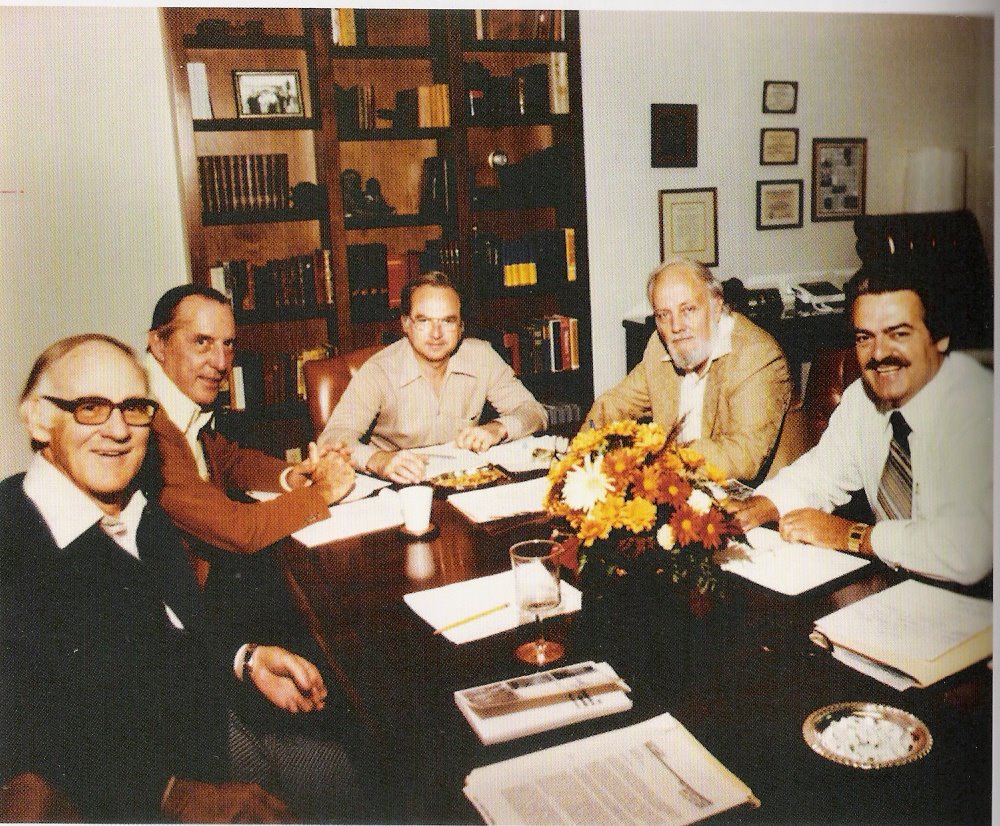
The final section of "Discourse 3" is particuarly interesting and in need of reading. Paulk and Ern Baxter begin by continuing their discussion on water baptism from Part 1 and move on to touch on the vital subject of authority.

Spiritual authority was taken by Ern Baxter and his brothers including Charles Simpson and Bob Mumford and taught and well received. Unfortunately that teaching was taken to excess by those to whom they taught and it became badly publicised. But as I have experienced in my own life, abuse of authority doesn't excuse no use. The Scriptural principles still stand and this interview is an excellent expounding of those correct principles. Ern Baxter closes by talking about the need for older Christian leaders. Note particularly Earl Paulk's acknowledgment of Ern Baxter's ministry as an apostle.

Thanks again to my friend Hugh for his help I can offer, for those who are interested, the entire collated "Discourses" document in Word format, it can be found here.

The final part of the 3rd Discourse follows:

Earl Paulk: I hope you understand that because more and more I am totally convinced about the responsibility of setting apart our children for purposes of God. That comes out a mile though and I make no bones about it – I want them to be in the Kingdom of God, I want them to be claimed. I don’t know that this analogy is right on but maybe it will help a little. The Bible talks about a woman being married to an unbeliever – it said the bed is sanctified. In other words it didn’t save the husband – the unbeliever – but there’s a sanctity about it. Now it does not save the child but the child certainly while it’s in the covenantal part you have is set apart, will not lost so far as they come to their own knowledge of Christ. They come to that and then is the time for their own baptism and the other part that we have been sharing today. So I am a strong believer – I can hardly wait to bring my children to the altar, to let the community (even before I understood it as I do today) to let the community help me in responsibility. If we understood this we would have less rebellious children among us. We would have more of them coming to a knowledge of the Lord Jesus Christ with personal experience so I think that this is critical in your pastoral responsibility – to bring those children and then to put them in places where they learn about things of the Lord so I am strong with that. Are you in a good mood this morning Brother Ern?

Ern Baxter: Yes.

Earl Paulk: Good then I am going to press you a bit. (*laughter*).

Ern Baxter: I may lose it! (*laughter*).

Earl Paulk: Somebody gets baptised and they didn’t have the knowledge of what we are teaching here today of the full provisions up to and including the enthroned Christ’s promise to us of the Holy Spirit. Is there a place to bring folk back into baptism? When they got up to Ephesus they said, “Well we were baptised in John into repentance”. But he didn’t say “Well let me come over and lay hands on you to receive the Holy Ghost”. He said he would baptise them in the Name of Jesus. Is there a place to be baptised, if there is not how we should deal with folk that didn’t get what we preach and believe because they didn’t know. They said at Ephesus – that we didn’t know. We were baptised to the knowledge. Are we leaving some folk in a place that is susceptible to Satan?

Ern Baxter: Of course we are dealing with great historical issues as you well know Bishop. And we are dealing with even the Reformation and the Anabaptists insisted on believer’s baptism while the magisterial Reformers continued to baptise babies. Personally I was baptised as an infant in the Presbyterian Church. Now when in my teen years I came into a dynamic experience of Christ and the Holy Spirit, I forgot that I had been baptised as an infant – it didn’t even enter my mind. And I headed for the waters of baptism … man, I had an experience in the waters of baptism, it just didn’t go through a ritual. I was baptised in a Canadian river and as I came up and out of the water and was wading to the shore, I was sure that there was a brick wall between me and my past. I was so sure that brick wall was there that I stopped in the river and turned around expecting to see it.

Because in that baptism I realised that I had been cut off entirely from my past. But I had been cut off – that when I went down in those waters, my history in the old Adam was dead and when I came up out of those waters my history in the New Adam began. And it was dynamic. Now I think that anyone who has had their process tampered with either by infant baptism (and this is dangerous talk) – I think they have a perfect right to get their foundations straightened around. I’m not going to fuss about formulas and all that – I think too much has been made of that. I believe in one baptism – and if you’ve got a baptism you can build upon, then build on it. But if you have got an infant baptism like I had, I didn’t even sit and intellectually controvert on it, I forgot I had even done it! My dad afterwards smiled and said, “Son did you know that you were baptised as a baby?”. I said, “I’m sorry dad – I didn’t remember that – I wasn’t there!”. You see – baptism requires rationality. You have to repent and be baptised. People say well God gives the baby faith. Well that’s extra-biblical. That’s where you bring a system to the Bible and make the Bible fit your system instead of bringing your system to the Bible and letting the Bible revise your system.

Earl Paulk: Well I had an experience somewhat similar to that in a way. I was not baptised as an infant as an act of my family’s will but I started kindergarten in Detroit, Michigan when I was about five years old and before there we were in Logan, West Virginia so I must have been about four. And some of you have heard me relay the experience – that as Daddy was baptising even that early age, I sense a tremendous need as a little child (you’ve got to know how a four year old child thinks) and Mother was at home with my sister.

So when I saw what was taking place and Daddy got through baptising I am standing on the shore waiting for Daddy and I cannot remember now because that was 60 years ago exactly what happened in me but I know I had a need. I said “Daddy I want to be baptised”. He said, “Son do you understand what you’re asking about?”. And I said, “Yessir”. He said, “Why do you want to be baptised?”. I said, “I just need to be baptised – I just want to be baptised”. Now what sins does a four year old kid have to repent of? Except being born in sin? But in my little childish way I felt the great need. So Daddy said, “Alright” and he took me out and called everybody’s attention. They were all walking away. I remember this part as if it were five minutes ago. Daddy started weeping and holding me in his arms. And he said, “The delight of my life is to baptise Earl Jr here today. My namesake. My oldest son. He said he knows what he’s doing”.

And he preached a little sermon about baptism and I remember how cold it was. He was holding me and he was wet because he had been baptising. Daddy was holding onto me – I remember that. Then he said these words, “I would rather this boy preach the Gospel of Jesus Christ than to be President of the United States”. Now there’s not a good chance that I was going to be President so I became a preacher but anyhow that was his words. And I remember that he baptised me, took me home and wrapped his overcoat around me, walked in the front door and Mamma said, “Earl I knew you would let that child fall in the water – I told you when you left he would fall in”. Now that was a valid experience Ern. But when I was a thirteen-fourteen year old boy we had a great revival in Greenville and I was moved like never before. I remember being baptised but I wanted to be baptised again because the Holy Spirit had taken on a meaning that He hadn’t before. And I was baptised again and it was very meaningful. So I think what you said is very meaningful and it’s an apostolic teacher among us to say it. If you can build on your baptism – do it. But if you feel you need to do the first works over, then don’t be embarrassed to do that either. Does that make sense?

Ern Baxter: Yes and one more thing because I know as pastors you are going to face this. When there are children who are still subject to their parents and there is a desire on the part of a child for baptism, I won’t baptise the child on the basis of it’s own desires. And I was interested – I was listening carefully to how the Bishop’s father dealt with him. “Do you understand this son?”. I have had parents come to me and say, “My seven year old Johnny understands it”. And I say, “That’s fine but I will baptise your Johnny under your authority. If there’s any mistakes made here, it’s not mine. I am not going to be the one responsible for that child. You are the divine agent for that child. Now if you tell me that you want me to baptise that child under the authority of your parental edict I will do it. But I won’t do it on my own”. In that way the child remains under the oversight of it’s parents and it’s parents have to be able to tell me that they are satisfied that the child is ready for baptism and then I will baptise the child on the authority of the divine agent in the child’s life.

Earl Paulk: And this is consistent when you talk about authority. I am convinced that one of the greatest voids in the last few years has been understanding what we mean by authority. When Jesus said, “All authority has been given to me in heaven and on earth” and then how as Brother Baxter has taught us, the Trinity is an example and it moves right on down to the family – we may be equal but there is a function that differs in authority. There’s a mother, a father, pastors, elders – all these say authority. They say structure. And I am a strong believer that if you understand that covering then God respects that covering – He respects that authority. And I thought his message on Eve listening to Satan – all she had to do was say “I will check in with my husband on that”. And knowing that he doubtless would have said, “Well the Father God will be here in a few minutes, we’ll check” and there would never have been the problems we’re in today. Now that happens every day in family life and church life. I want to tell you that nobody in their right mind wants to be in authority in your life. But if God puts them there they are in authority.

One of the reasons why I brought Ern Baxter here was to submit to him. I wanted him to see this ministry from a different place than he has seen it before – just visiting. I wanted to hear him talk about the Eucharistic approach. In a lot of ways his teaching has been an act of mine to submit. My church can tell you that I said, “Bring an Ern Baxter here is preparation to go into the Cathedral”. Because we’re not just going into a bigger building, we are coming to a new comprehension and understanding – even at this place in my life – I am still learning. And I want to know that the future of the church is safe and secure in not only a good theological basis, but also the practice. In the light of that this was an act of submitting because I have listened more intently that anyone else in this place because if I make a mistake and I am your covering then you make a mistake in me. And I have got to be sure and to bring an apostle among us – and I say not only by being a fact but I say that by revelation, the Lord has spoken to me a long time before I ever met Ern Baxter, who the apostles were who I should relate to. And when he comes among us, I give him full and complete liberty because I know the authority that he brings with him is my protection. It is the protection of what we are doing here. Because we could very easily get off on a tangent and go back into formalism that in ten or fifteen years is just another ritual.

Or you can go the other extreme and become so congregational and empirical and experience orientated in what you are doing that the twain will never meet and we stay in total derision the rest of our lives. Somewhere there comes a meeting of that form and power. Of that Word and Spirit and so I hope you understand that when I talk about authority it is not just me talking and saying “Ern Baxter I submit to you”. When I bring him to the church that I am responsible to and to the pastors that I cover it is an act of submission. And for that reason I am comfortable with it and when you talk about facing God and the ongoing eternal life that we live, you can’t play games with that. A little flesh here and there. You can handle that and come to the table and God will deal with it. You are talking about eternal truth! Know the truth and the truth will make you free! You go back to your church and take the truth that will set them free when you teach them properly. When you teach them what the things of the Lord are about. We have had such cheap approaches. You can go into arenas and there is cry to make a decision for Jesus but we leave them there. I have been the chairman of Billy Graham crusades and Oral Roberts crusades. I know what it is. The church is a redeemed community that can no longer afford just a cheap way in and out. If they do that that may be God’s economy but we have got to take it and go somewhere with it. Does that make sense Ern?

Ern Baxter: Oh yes that is so right. Let me just say a word about authority Bishop. I adopted a slogan years ago that any man who wants authority is not qualified to have it. If a man lusts after authority he is not qualified to have it. A man who takes authority must be reluctant. He realises what he’s got. When Paul talked about his authority he wanted to protect it. He said “My authority is not to tear you down but to build you up”. One of the dangers of the ministry is that when Peter said the elders were not to lord it over the flock – why did he say that if it were not possible for the elders to lord it over the flock? You have authority. I am talking to you now as servants of God. You have authority! You didn’t just get it in your ordination. If you are called servants of God, then God has given you an authority. That authority is not to be abused and if your lust is for authority then you don’t qualify to have authority. You have got to be willing to hold that authority in the tension of humility and to exercise it to build up and not to tear down. Don’t lord it over the flock of God. You have the ability to do it. God has given you the gift and the placing to do it. But authority is a powerful thing – it’s like fire. You have got to keep in the grate and you let it loose and it will burn everything up.

Another little thing that I have observed about the Democratics Presidential candidate – it’s an interesting thing, I watched it on the news. One after another of these potential candidates with young families are opting out because of their families and I said to Ruth, “I wonder if a man is fit to be President of the United States until he has raised his family”. Just a thought. But there is something about the word “elder” that is not talking about a beardless youth! Just because I’m old, I don’t want to put a premium on age but at the same time I would to God in my young days that I had been able to snuggle up to older men much more than I was. We retire ministers and there is gold in their hills! We stick them out with a hot plate and a room overlooking a slum somewhere and give them 25 dollars a month! We have thrown out our wisdom! And I look at the Bishop and I look at his age and I don’t treat that lightly! And I think that some of you younger men that are coming up – handle your authority carefully and as you handle it carefully, it will grow and it will be salutary and sanctifying but if you – I’ve watched young ministers go off half cooked and they are “Reverend So-and-so” and look … you are a servant of Jesus Christ and when God wanted to describe His servants, He used the most demeaning term in the Greek language. He called us “Diakonos”. The lowest menial task both in Grecian culture and Hebrew culture was to serve tables. And that is the meaning of deacon. Find out what your table is and serve it! Let the other man serve his table! I know my table and just want to serve it. That’s all! And after I have done the best I can and when you feel you have done everything you feel you should do, you still have to humbly admit I am yet an unprofitable servant. Jesus said that! That isn’t mock humility – that is just facing the facts! I sometimes shudder when men introduce me with the kind of epithets they use. I know in the grace of God that has its place but I know me so well! I know that as I read the newspaper and as I read about crime and what people have done that those people are my Adamite brothers and sisters and that everything they have done, I have the human potential to do the same thing and if it wasn’t for the grace of God I would be languishing in the same jails that they are in. This humility will help you to handle authority.

Earl Paulk: Let me give you one final word that I feel the Spirit of the Lord would have me share with you. It’s a word that I gave here and I really shared in community. It is an explosive expectation. I believe the proper truths about the habitation of God and what we are sharing about the Holy Ghost that when we walk into the house of God to the table of the Lord properly understood that there should be such expectation that there would be healings without having great displays of it. That normally the functioning of the body of Christ in its proper understanding of koinonea should develop such a habitation of God that when we come in it releases the Word and it releases the anointing and it releases the mystery of the sacraments. All of that becomes a part. There are some key words! It says “When they were come together”. There is something powerful in that coming together. Your hurts are dealt with. All of a sudden you transcend the Adamic devastation and the Spirit comes alive and begins to minister one to the other. Healings take place. Things begin to be accomplished and then we go out into the world after we have washed one another’s feet cleansed and purged that through the strength of God we touch the systems of the world. But until we’ve come and understand the washing of feet properly – cleansing ourselves and coming away from that society and then going back out. But we have to keep coming that’s why Jesus taught on a daily basis. “Forgive us this day our daily sins – give us today the daily bread”. And that’s why I believe what we are doing here is so important.

Saturday, August 26, 2006


"God is Not a Fire Escape!" - An Interview with Ern Baxter on Seeking God.

Question: How can people be motivated to seek the Lord?

Ern Baxter: Two things motivate us to seek the Lord: crises that come into our lives and also what I call process, which is our growing, maturing relationship with the Lord. When we talk about seeking the Lord, it’s difficult to completely separate the two. A person must have some kind of rapport with God to begin with. Most of the men in the Bible who came into times of crisis did so out of the process of their relationship with God. The crisis was an interruption, a confrontation or course change in the flow of their lives. Seeking God is more than a matter of prayer or intercession. It’s a combination of watching and praying to heighten our sensitivity to what’s going on. Hidden in whatever is going on is a clue to whatever the crisis is about. Prayer without watching is only half the solution and watching without prayer gives you a nervous breakdown.

When we seek the Lord, we also need a good dose of patience. On one occasion I experienced a crisis that indicated a significant change was about to take place in my life; one of the many course corrections that have taken place because of the nature of my calling. I was convinced that God was in the change, yet the circumstances surrounding it seemed to drag on and I got impatient. One morning as I was driving to church, I blurted out, “God why don’t You listen to me here? Let me get this change over with”. He just shot back like lightening, “Why don’t you listen to Me?”.

Question: Does the Lord allow situations to come into our lives to intensify our fellowship with Him?

Ern Baxter:
Yes and the Lord Himself is the best example of that. The Bible tells us He did always those things that pleased the Father. But He was constantly facing crises; the greatest were the betrayal, the trial and the Cross. In all of those, He was very much in the Father’s Presence in prayer. Hebrews 5:7 says, “In the days of His flesh when He had offered up prayers and supplications with strong crying”. In several crises He cried out to the Father out of His humanity. Crises were simply part of the process of His relationship to the Father.

Life consists of process and a crisis. A marriage relationship is a good example. A couple will go along for a time and then they encounter a crisis, large or small. Eventually that crisis passes and they settle down, go along for a time and then hit another crisis. They probably won’t handle the crisis well if they’re not handling the relational process well.

Question: Do some people go from crisis to crisis without a sense of the process always in or out of a panic?

Ern Baxter: Yes that’s true. Once I was close to a young man in my church, but he was weak. He’d walk with God enthusiastically but then he’d start to wane and he’d lose his job or experience some other disturbing reversal. It was a pattern. Each time he’d come to me and say, “Well Pastor, I guess I blew it again. I lost my job”. I’d say, “Okay lets pray and get this straightened out”. He would get fixed up, find another job and be fine, ready to go to the ends of the earth. But it was as if he used God in crises and forgot Him in the process. One evening he came to see me to say good-bye. He was leaving his wife for another woman and there was nothing I could say to dissuade him. We wept together and he was gone; it was obvious he had made up his mind.

I never did hear from him again but about three years later I was listening to my car radio and I heard that this man had been found dead in the water alongside his boat. I immediately pulled off the road, found the nearest pay phone and called his ex-wife. “Is he the man they found?” I asked. Sadly he was. Here was a man who used God in crisis. I’m not pronouncing judgement on his spiritual condition but rather pointing out a principle. God is not a fire escape. He’s someone you learn to live with. Romans 7:4; “Ye also are dead to the law by the body of Christ; that ye should be married to another … that we should bring forth fruit”. Again our relationship to God is like a marriage which is both crisis and process. But it’s a relationship that you either handle or mishandle.

Question: Does God allow the crisis to come into the process to strengthen our relationship with Him?

Ern Baxter: Yes and Job is a great illustration of this principle. God tested his faith and God tests our faith as well. But how He tests it is up to Him. That’s one of His prerogatives. If He didn’t test us, we would never grow. Remember the first step you saw your child take? If there wasn’t a first one, he’d never walk.

Question: Do you think that many times God allows crises in our lives to sharpen our hearing?

Ern Baxter: That’s right. Often when we’re praying we rush in and tell God a list of things, walk out and slam the door. We don’t even have the courtesy to find out if He would like to say something. Our amen may not be God’s amen.

Question: How do you handle the crises that come?

Ern Baxter: The circumstances in which you are directly or indirectly involved are always changing. In my life, for example, the death of my first wife was a severe jolt. That’s not a daily crisis; something like that only happens maybe once in a lifetime. But whether it’s a death, a financial reverse or an accident we can handle it if our relationship with God is based on a process rather than a crisis.

Question: It might be helpful to hear how you faced the change in your relationship with William Branham, whom you ministered with for some time?

Ern Baxter: In the ministry with William Branham, I saw a dimension of the supernatural that had In it such seeds of Christian unity and other good fruits that my excitement was hard to contain. But when I saw carnality start to invade the movement – exaggeration, misrepresentation, metaphysics and eventually the breakdown of many of the healers in critical areas of their lives because they couldn’t handle the crowds, the popularity or the money – I had to withdraw from it. That was probably one of the most traumatic times in my life. I did a lot of praying at that time, a lot of groaning. In fact I did a lot of screaming because I was close to an emotional breakdown. A tremendous move of God had been sold out so cheaply; it was difficult to handle. If I hadn’t had an experience with God, if I hadn’t had a consciousness of His sovereignty, if I hadn’t had some kind of relationship with God based on process, I don’t know what I would have done.

I had maintained the pastoral oversight of my church while working with Branham and I went back and gave myself totally to that. I was now pasturing a church whereas before I had been with thousands of people in city-shaking meetings. It was quite a shock. I would go to my study, get down on the floor and just groan. I’d talk to God and just wait. I couldn’t do anything else. If it were not for my relationship with God, I could have taken the extreme position that Christianity was a “bunch of bunk”. But I couldn’t do that because it wasn’t a matter of Christianity, it wasn’t a matter of the healers; it was a matter of who was the most important person in this, and that was God. God wasn’t bunk to me. I knew that. I knew God and I knew where God was.

Question: What did that experience work in your life?

Ern Baxter: Romans 5:3-4 says, “Tribulation worketh patience and patience experience, and experience hope”. Tribulation means “pressure”. God lets pressure come into our lives so that we get experience. There’s nothing like experience. I once heard a story about a man who lived on a hog farm all his life, raising hogs and doing a good job of it. He learned from his dad. But one day he decided that his boy wasn’t going to learn hog farming by trial and error as he did; he was going to go to an agricultural college and learn how to be a smart farmer. So off his son went and after graduation he came back to the farm and his dad told him to go ahead and make some improvements. He did and the pigs began to die.

His father realised that his son had built a fancy new operation, but forgot to put proper ventilation in it. So the old man tore it all down and built what he had done before. It takes a lot more than a degree in college to learn the facts of life. Because of his experience, the old man really ought to have been a lecturer at that college.

Question: Without your experience, you wouldn’t have the relationship with the Lord that you have now would you?

Ern Baxter: Right. A word that is missing from our vocabulary today is endurance. Hebrews 12:6 says, “Whom the Lord loveth He chasteneth and scourgeth every son whom He receiveth”. If you endure chastening then He deals with you as a son – if you endure chastening. It’s not necessarily punishment; it can be instruction. To endure means to wade through until it’s done. That’s where patience comes in .

A lot of Christians live from crisis to crisis and wonder why their crises are so hard. It’s because they don’t develop a process. All God is saying in a crisis is that if you move in close to Him and develop a process then you might not need all those crises.